
Ultra-Fast Fiber Marking Machine Solutions
More than 60% of FTTH lines utilize automated marking and dyeing to keep up with demand. Still, many producers miss the advantages of high-speed fiber coloring equipment. These machines enhance throughput and ensure repeatable quality.
This piece presents industrial Fiber cable sheathing line system solutions for optical fiber and textile production. We show how a fiber coloring/dye machine fits into a draw-to-coat workflow and an FTTH line. You’ll discover how high-throughput dyeing increases color coding, reduces manual handling, and enables inline proof testing.
Leading suppliers deliver expert production technology training for customer teams. With R&D support, systems are tailored to exact requirements. Notably, reputable companies guarantee a 100% inspection rate before shipping their products. Standard commercial practices apply, such as T/T and L/C payments.
The industry standard for warranties and logistics includes a one-year warranty from installation date. Coverage includes parts replacement for manufacturing defects. Travel and lodging for on-site support are typically buyer expenses. Packaging often comprises PVC thin film for main units and wooden cases for smaller components. Custom packing can be arranged upon request.
Essential Points
- Integrating high-speed coloring machines improves throughput and consistency across FTTH/textile lines.
- Vendors provide training, customization, and 100% pre-shipment inspection.
- Fiber dye machines improve inline proof tests and reduce manual spool handling.
- Payments commonly use T/T or L/C; warranties usually start at installation for 12 months.
- Standard packing uses PVC thin film and wooden cases; special packing is available on request.
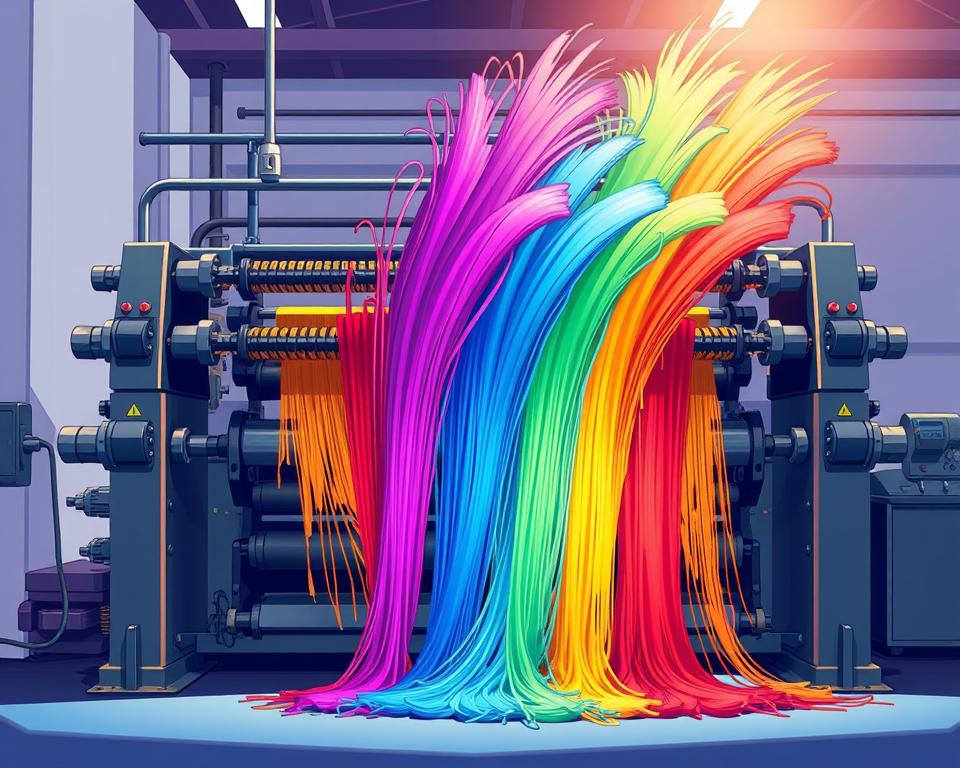
Overview of High-Speed Fiber Coloring Systems
High-speed fiber coloring systems deliver markings or colors that are consistent, without compromising fiber strength or clarity. These machines match the speed of fiber draw towers and coating lines, preventing production delays. Focus areas include color accuracy, automated QC, and less manual handling. This meets the needs of both the telecom and textile industries.
What defines a high-speed fiber coloring solution
A true high-speed fiber coloring machine applies colorants or inks accurately at high speeds. Precise control of width, contrast, and adhesion is maintained. That way optical loss and mechanical integrity remain intact. The system features include the use of solvent- and UV-curable inks, precise feed control, and efficient curing stages for optimal operation.
Performance Benchmarks: Speed, Accuracy, Uptime
Performance requirements depend on the application. Single-line markers can run up to 3,000 m/min. Ribbon coloring targets ~1,000 m/min with accurate codes and low scrap. Focus on registration precision, color consistency, and the ability to repeat these results over long periods is critical.
Higher uptime is gained through automation, like automated spool handling and real-time testing. They reduce manual checks and spool swaps. Predictive maintenance and modular design help decrease downtime. This results in consistent production levels.
Where It’s Used: Fiber & Textile
Optical fibers use these systems for tasks such as FTTH cable marking, fiber secondary coating line, telecom color coding, and ribbon marking. They integrate with draw/coating to keep flow continuous. Real-time testing assures that each fiber segment hits the required strength and clarity standards.
Textile know-how helps improve dye control, slash waste, and save energy. Lessons from yarn and fabric dyeing have led to better fluid management, automatic mix adjustments, and sustainable operations. Cross-pollination reduces time and improves quality across both sectors.
| Metric | Optical Example | Textile Parallel |
|---|---|---|
| Top speed | Up to 3,000 m/min for single-line marking | High-speed yarn dyeing lines up to 1,000 m/min equivalent throughput |
| Accuracy | Registration within ±0.5 mm, stable color-code fidelity | Consistent color repeatability across batches |
| Uptime enablers | Automatic reel handling, inline proof testing | Automated dye dosing and closed-loop quality control |
| Integration | Seamless connection to fiber draw tower and coating lines | Integration with dyeing baths and finishing lines for minimal handling |
| Sustainability gains | Reduced scrap, solvent recovery, LED curing options | Lower water and chemical use via precision dosing |
Fiber Coloring Machine Overview
Fiber coloring machines apply durable color codes to optical/industrial fibers. Precision applicators, fast curing, tension control, and smart sensors are used. The result is efficient, steady production. It is designed to easily integrate with existing drawing and coating lines. Additionally, it connects to inline testing and automation systems for streamlined operations.
The applicator or marking head applies UV inks or liquid dyes accurately. Then, LED modules or focused UV lamps instantly harden these inks. This allows fibers to move quickly without delay. Guides/tension control preserve geometry during marking. Ink reservoirs and modular tanks supply ink consistently, aided by pumps and filters. PLC/HMI provide easy control and rapid changeovers. Sensors verify placement so every mark meets spec.
Coordinated Operation
The applicator accurately times deposits according to fiber movement, controlled by sensors. Curing locks marks for immediate downstream handling. Sensors then gauge color intensity and accuracy. Should an error occur, the system either tags the error or excludes the faulty section. This ensures that speed, ink flow, and curing work in harmony, maintaining high-quality output.
Line Compatibility
These modules mount easily behind a fiber draw tower or along a secondary coating line. Different mounting options cater to various fiber types. Whether for tight-buffer or loose-tube fibers, the unit adjusts accordingly. Multiple coatings/profiles are supported. Compatibility exists with equipment from Sumitomo, Furukawa, Corning. The result is seamless integration for plants.
Inline Proof Test & Automation Integration
Directly after marking, inline proof testers check the fiber’s physical and optical quality. Any defects are instantly fed back to the coloring machine for correction. The system also integrates with automated dyeing equipment and spool management, minimizing manual intervention. Integrated flow significantly cuts downtime. It also aligns coloring, testing, and spooling for maximum efficiency.
| Process | Component | Benefit |
|---|---|---|
| Mark application | Applicator / Marking head | Precise placement; repeatable patterns at line speed |
| Ink supply | Modular ink tanks and pumps | Continuous feed; reduced changeover time |
| Curing | LED or UV lamp system | Fast hardening; lower energy use with LED |
| Fiber handling | Tension control and guides | Stable geometry; fewer marking defects |
| Quality assurance | Registration sensors and inline cameras | Real-time inspection; automatic rejects |
| Control | PLC / HMI with data logging | Recipe recall; production traceability |
| Line integration | Mounting kits for fiber draw tower and coating lines | Smooth inline fit; supports tight buffering |
| Automation | Interfaces for RHS and proof testers | Reduced manual handling; integrated traceability |
Advanced Fiber Dyeing Technology
High-speed lines require precise marking and fast curing. Modern dye tech gives durable marks with minimal performance impact. These techniques improve adhesion and consistency for single fibers and fiber ribbons.
UV Inks + LED: Benefits
Ultraviolet hardening inks provide high-resolution, durable markings that cure swiftly on fiber coatings. They stay in place during cabling and connectorization, resisting abrasion.
LED curing technology reduces power consumption compared to traditional UV lighting. Less heat, longer lamp life, and lower noise also help spool layouts. These features make LED technology a greener choice for non-stop production.
Color coding systems for multi-fiber and ribbon lines
Color codes simplify fiber and cable identification. Options span simple markers to advanced systems for 6/12-fiber setups.
Applying consistent colors helps technicians in splicing and testing, leading to quicker installations. Effective color coding reduces both the time spent handling fibers and the mistakes made during on-site work.
GFP Series: Speed Reference
GFP systems are optimized for fast optical cable marking. Its single-line models can mark at speeds reaching 3,000 m/min for uninterrupted tasks. Ribbon/bundle models run up to ~1,280 m/min.
Alongside inline proof testers, the GFP series offers various expansions for buffering and verification. It adapts marking capacity without full line changes.
Automation: Dyeing & Handling Systems
Modern automated dyeing equipment combines accurate Fiber coloring machine coloring with efficient handling. This integration accelerates the dyeing process from application to curing and testing. It significantly reduces downtime. Additionally, it minimizes manual intervention by seamlessly linking critical stages into one workflow.
Auto Reel Handling
Nextrom’s Automatic Reel Handling System eliminates the need for frequent manual changes of the take-up reel. This innovation means operators avoid doing around 24 spool changes per shift. Automation reduces repetitive work and improves machine efficiency.
Automated Break Recovery
Automated break recovery streamlines re-threading. Originally, manual re-threading was a common task, occurring up to four times per shift. Automation cuts downtime and keeps production continuous.
Less Labor, Fewer Errors, Better Safety
Advances save labor by reducing spool changes and re-threading. Reduced physical handling cuts the risk of spool damage and reduces waste. Furthermore, the reduction in manual tasks lessens noise exposure and the risk of injury, improving overall safety on the production floor.
| Metric | Manual | Automated | Impact |
|---|---|---|---|
| Take-up reel changes per shift | ~24 changes (every 20 minutes) | 0 changes with RHS | Eliminates 24 interruptions; higher uptime |
| Payoff spool changes | Baseline | Reduced by 50% | Less operator time; smoother feeding |
| Proof test break events per 1,000 km | 2–6 breaks (~4/shift) | Automated recovery for all breaks | Faster restart; fewer manual interventions |
| Ink tank run length | Typical shorter cycles | Up to 1,000 km per acrylate tank | Lower consumable swaps; reduced maintenance |
| Noise and operator exposure | Higher; frequent handling | Reduced by optimized spools and LED curing | Quieter environment; less PPE required |
High-Speed Ribbon Lines & Production
Modern ribbon lines combine coated fibers into a flat ribbon. Geometry and attenuation are tightly controlled. Key enablers include precision alignment, controlled glue, and fast curing. Production flows smoothly without sacrificing quality. Ribbon formation, FRP 05 style lines, and inline proof testing are critical in high-throughput settings.
Ribbon creation begins with exact spacing and placement. A thin adhesive bead bonds fibers; tensioning combats micro-bends. Rapid cure stations lock the bond for line-speed movement. Controlled glue keeps optical quality and eases downstream steps.
FRP 05 lines excel in scale. They can craft ribbons with up to 24 fibers at speeds hitting 1,000 m/min. These systems combine refined tension control, high-accuracy ferrules, and coordinated capstans. Fiber pitch/alignment stay consistent across the process. The FRP 05 line, therefore, stands as a dependable solution for central-office and FTTH ribbon supply networks.
Inline proof testing confirms ribbon quality. Test heads check tensile/continuity immediately post-formation. On weakness/break, the system rejects or auto-adjusts. This immediate feedback reduces waste and blocks faulty ribbons from progressing to cable assembly.
Ribbon lines may add marking/color coding. IDs survive later processing. Together, coding + proof tests improve traceability and QC. Syncing glue/formation/testing yields clear benefits for throughput.
| Process Stage | Function | Typical Performance Metric |
|---|---|---|
| Fiber alignment | Arrange coated fibers to target pitch and flatness | ±5 µm registration |
| Glue application | Deposit controlled adhesive bead without excess | 50–150 µm bead width |
| Curing | Rapid hardening to lock ribbon form | UV or thermal cure in |
| FRP 05 ribbon formation | High-throughput assembly for up to 24 fibers | Up to 1,000 m/min production speed |
| Inline proof testing | Detect weak bonds, breaks, and tensile issues | Immediate reject/feedback within 0.5 s |
| Marking and coding | Apply ID that withstands ribbon processing | Permanent color codes per fiber |
How Coloring Integrates with Draw/FTTH Lines
Modules must be placed away from the glass to protect cladding. Typically installed after primary coat or in secondary coat stages. This keeps marks on the exterior and preserves optical quality.
Workflow Fit
Technicians integrate coloring modules directly with coating apparatus, allowing ink to cure on the fiber’s polymer layer. This setup keeps output consistency from the fiber draw tower and uses inline UV or LED light for immediate curing. It ensures precise IDs without performance damage.
Upstream/Downstream Interfaces
Integration uses mechanical couplings, tension control, and synced protocols. Together, these elements deliver seamless speed alignment and communication of operational statuses. This harmonization between the draw tower and later stages like ribbonizing ensures efficiency. Inline feedback optimizes output and reduces waste.
Throughput Gains & Downtime Cuts
GFP marking systems can operate at speeds up to 3,000 meters per minute, matching high-demand productions. RHS and fast break recovery significantly cut downtime. They boost efficiency and lower stoppages over long runs.
Industrial fiber coloration system maintenance and warranty considerations
Peak performance depends on clear warranty, solid service, and proper shipping. Pre-shipment agreement on inspection/acceptance/installation is essential.
Warranty Terms
Warranties typically start at installation and last one year. Coverage focuses on parts with manufacturing defects. Misuse, wear, and external damage are excluded and borne by the buyer.
Service support
Service support includes deploying onsite technicians and providing training through seasoned engineers. Renowned suppliers, including Siemens and Rockwell Automation, run comprehensive training programs. Technicians are available for commissioning and periodic checks.
Customization led by R&D for special lines is common. Suppliers conduct thorough inspections before shipping and provide spare parts kits to reduce downtime. Travel/lodging and certain transport costs are typically buyer responsibilities.
Parts Policy
New systems come with spare parts packages, either included or as an option. Warranty periods see replacements for defective parts provided by the vendor. Out-of-warranty repairs require clear pricing and timelines.
| Area | Supplier Role | Buyer Role | Remarks |
|---|---|---|---|
| Warranty period | Provide one-year coverage from installation | Request documentation and schedule acceptance test | Start date tied to factory acceptance or onsite commissioning |
| Service support | Deploy on-site technicians and offer training | Cover technician travel, accommodation, and local transport | Remote support may reduce on-site visits |
| Spare parts | Supply spare parts packages and fast replacements under warranty | Maintain inventory and order consumables as needed | Agree lead times and pricing for out-of-warranty parts |
| Packing & shipping | Use PVC film for main machines and wooden cases for auxiliary parts; offer custom packing | Specify special packing needs and handle customs | Custom packing may add cost but protects equipment during transit |
| Installation & acceptance | Provide assembly, alignment, and commissioning support per contract | Prepare site, utilities, and local labor; sign joint acceptance tests | Joint acceptance validates performance against agreed specs |
Logistics & Installation
Standard packing: PVC film for main units, wooden cases for auxiliaries. For fragile or distant shipments, suppliers offer custom packing. Defining roles prevents delivery and setup confusion.
Thorough inspections before shipment and factory acceptance testing limit onsite issues. After installation, joint testing confirms the system’s performance, starting the warranty period. Defined roles for packing and installation smooth the transition, minimizing downtime.
Sustainable Fiber Coloring
Modern lines cut operating costs and meet environmental goals. Upgrades in curing/spools/consumables improve efficiency and comfort. These advancements make the environment quieter, cleaner, and improve productivity.
LED Curing Benefits
LED curing significantly reduces power consumption compared to traditional UV lamps. Less heat stabilizes temperatures and reduces stress on downstream gear. LEDs last longer, meaning fewer replacements and less waste.
Low-Power, Low-Noise Designs
Improved spools/transport lower motor load. At similar operational speeds, advanced spool designs have been shown to cut power usage by over 50% at speeds of 3,000 m/min and decrease noise by more than 10 dB. These innovations help lower overall power consumption and make hearing protection less essential.
Materials Management: Longer Runs, Less Waste
Advanced systems run longer on one acrylate tank. By being able to color up to 1,000 km of fiber from one tank, the frequency of ink changes decreases, resulting in lower consumable waste. This efficiency also reduces the need for applicator changes and maintenance, lowering downtime and the amount of replaceable parts needed.
Automation underpins sustainability. Automated control/proofing reduces errors and scrap. Together with LEDs/efficient spools, footprint shrinks and long-term costs fall.
Textile Dyeing Crossover: Lessons
Insights from textile dyeing equipment offer valuable lessons for fiber coloring, centered on process control and repeatability. Modern textile methods stress closed-loop dosing and inline checks. These strategies drastically reduce waste and deliver consistent output quality.
Shared Principles with Yarn/Fabric Dyeing
Yarn dyeing shows the need for precise metering, tension control, and stable geometry. Implementing these controls on optical fiber delivers uniform dye application and steady dye absorption.
Similarly, fabric dyeing machinery leverages step-by-step processes and recipe management to achieve consistent color. This approach improves yield and reduces rework over long runs.
Automated Dye Control & QC
Plants use closed-loop metering and spectrophotometry for shade accuracy. When these systems are adapted for fiber lines, they hold consistent coat weights and minimize color variations over time.
Inline quality control often employs rapid spectrometers and camera-based systems for precise adjustments. They catch deviations and drive real-time automated corrections.
From Textile to Fiber: Adapting Solutions
Fibers require ultra-clean handling, precise curing, and tight tension control. Elements like recipe servers, automated ink management, and detailed process analytics from textile coloring are adapted and scaled down for fiber lines. They are tuned for minimal volume applications, ensuring cleanliness and efficiency.
With software control/analytics and ink best practices, waste drops significantly. These steps also improve sustainability and protect optical fiber performance.
| Feature | Textile Gain | Fiber Use |
|---|---|---|
| Closed-loop dosing | Consistent shade across lots | Maintains coat weight; integrates with automated dye control |
| Tension & geometry control | Uniform penetration and hand | Protects fiber integrity; reduces microbends |
| Inline spectrophotometry | Rapid pass/fail color checks | Detects mark variance without damaging fiber |
| Recipe management | Fast changeovers, fewer errors | Quicker recipe swaps for different fiber IDs |
| Ink handling systems | Lower waste, safer storage | Low-contamination delivery systems for sensitive optics |
Selecting Suppliers and Setting Terms
Key purchase factors: price, lead time, support. Define payment terms early for fiber coloring buys. Vet credentials and align on training/testing expectations.
Payment methods often include T/T and L/C options. Determine if the supplier allows full T/T payments, tiered T/T based on progress, or uses L/C at shipment. Clarify the preferred currency, any bank fees involved, and who’s responsible for amendment charges.
Select suppliers by history, milestones, and references. Many credible vendors started with wire and cable equipment in 2005 and branched into optical gear by 2006. Check years in business and global installs for reliability.
Create a scorecard for competing quotes. Items should cover warranty specifics, packaging and shipping terms, and installation responsibilities. Require documented testing/maintenance agreements pre-award.
- On-site Training: Define on-site training scope and who covers engineer travel/lodging
- Customization: Confirm drawings and tailored designs for special needs
- Inspection/Testing: What is the pre-shipment inspection policy and can buyers witness factory acceptance testing?
| Item | Buyer Task | Supplier Detail |
|---|---|---|
| Payment terms | Negotiate schedule | Acceptable methods: T/T, L/C; milestone triggers; bank fee responsibility |
| Warranty | Obtain written clause | Coverage period, excluded parts, on-site cost responsibilities |
| Installation & training | Set scope and dates | Included hours, trainer qualifications, buyer travel costs |
| Spare parts & consumables | Request kit list | Recommended packages, lead times for ink tanks and applicators |
| Acceptance testing | Define tests | Witness options, documented results, remediation steps |
Before final selection, check references and review past projects. Clear terms and proven competence reduce risk. This supports a smooth commissioning phase.
Conclusion
Modern fiber coloring plus LED/UV curing and tight line integration improves throughput and color fidelity. These innovations allow marking speeds of thousands of meters per minute. They prove particularly effective in applications ranging from Fiber To The Home (FTTH) to industrial use. The outcome is a significant reduction in cycle times and waste.
Automation is pivotal. It incorporates automated dyeing with seamless reel handling and proof test break recovery. It reduces spool changes and manual steps. Consequently, this boost in efficiency leads to less downtime, minimized errors, and a noticeable cut in labor expenses. Offering a comprehensive system, including training, spare parts, and a clear warranty, reduces buyer risk over the lifecycle.
Design improvements promise sustainability and financial benefits. Use of LED curing technology, efficient spool layouts, and durable ink tanks decreases energy consumption, noise, and material usage. Through standardizing payment methods like T/T or L/C and insisting on thorough pre-shipment inspections, operators ensure consistent machine performance. This strategic approach enhances the long-term return on investment for their fiber coloring machines.
Related: Reducing Changeover Time on the Fiber Coloring Machine